Mini and Mighty: A Thoughtful Guide to Subtle Breast Augmentation
In this conversation with plastic surgeon Dr. Trace Browne of Amelia Aesthetics in Raleigh, we walk through the nuances of subtle augmentation.
“Ballerina boobs.” “Yoga boobs.” “Just a little something.”
Over the past few years, we’ve seen a noticeable increase in “mini boob jobs.” The goal is often a subtle, natural-looking volume that fits seamlessly into everyday life. But while the idea sounds simple, the decisions behind it are anything but.
What does “small” actually mean? Will you regret not going bigger? How do you choose the right size, shape, or placement when you don’t even know what it will look like on your body?
In this conversation with plastic surgeon Dr. Trace Browne of Amelia Aesthetics in Raleigh, we walk through the nuances of subtle augmentation, from sizing and profiles to newer techniques like Preservé, so you can better understand your options and feel more confident heading into your consultation.
What does “I want an implant, but not too much” actually mean?
This is one of the most common, and most challenging, starting points.
From a surgeon’s perspective, the goal is to get on the same page and speak the same language. Words like “natural,” “subtle,” or “not too big” can mean very different things from person to person.
To clarify that vision, your consultation will typically combine:
- Your own description of your goals
- “Wish photos” (what you’re drawn to visually)
- 3D imaging to preview potential results on your body
- A discussion of implant options and lifestyle considerations
Breast augmentation is not one decision. It’s a combination of variables working together. Size, shape, profile, placement, and tissue characteristics all interact. The goal is to align those choices with what matters most to you.
Are smaller implants becoming more popular?
Yes, there has been a clear shift. For a long time, breast augmentation was associated with a more noticeable, fuller look. Now, many patients are intentionally seeking a more understated result, something that enhances rather than announces.
That said, trends shouldn’t drive your decision. The most important factor is clearly defining your personal goals. If your goal is subtle volume, proportion, and natural shape, smaller implants can be incredibly effective. And importantly, choosing smaller does not mean you’ll automatically want to go bigger later.
What size counts as a “small” implant?
While implant ranges vary by brand, smaller implants generally fall into:
- Low 200ccs
- High 200s
- Low 300s
There are implants as small as the 100cc range, but those typically create very minimal visible change.
For reference, roughly 100–150ccs ≈ about one cup size, though this varies significantly depending on your body and anatomy. It's worth noting, cup sizes themselves are not a precise measurement and can vary widely between brands and styles.
Are there benefits to choosing a smaller implant?
There can be, especially long-term. Because smaller implants:
- Weigh less
- Place less stress on your natural tissue
- Are less likely to stretch or shift over time
This can translate to:
- Lower likelihood of implant malposition (movement over time)
- Reduced strain on the breast tissue
- Potentially more stable long-term results
It doesn’t mean complications can’t happen—but mechanically, less weight often means less stress on the body.
Is recovery easier with smaller implants?
Recovery depends more on placement and technique than size alone. However, newer approaches, especially placing implants above the muscle (subfascial) or using tissue-preserving techniques, can significantly reduce recovery time.
Some patients with these approaches report:
- Minimal discomfort
- Faster return to normal activity
- Less downtime overall
What is Preservé (breast preservation augmentation)?
Preservé is a newer technique that approaches breast augmentation differently. Instead of cutting through supportive structures in the breast, it:
- Uses blunt instruments to create space
- Preserves natural ligaments and tissue support
- Positions the implant within those natural structures
Potential benefits include:
- Less disruption to anatomy
- Reduced downtime
- Longer-term support of the implant
- Lower risk of bottoming out
It’s also typically paired with softer, more natural-feeling implants and smaller volumes (up to ~315ccs).
Will smaller implants still look noticeable?
Yes, often more than people expect. One of the biggest misconceptions is that smaller implants don’t make a meaningful difference. In reality, even a 200–300cc implant can:
- Restore lost volume after breastfeeding
- Improve shape and proportion
- Enhance how clothing fits
The result is often subtle, but still impactful.
When might a small implant not be the best option?
There are a few scenarios where a slightly larger implant may be recommended:
1. Loose or Stretched Skin: If there’s significant skin laxity, a very small implant may not provide enough volume to create the desired shape.
2. Wider Chest or Breast Footprint: A wider chest requires an implant that fits that width. Extremely small implants may look too narrow or out of proportion.
3. Avoiding a Breast Lift: Sometimes, a slightly larger implant can help fill out tissue and avoid the need for a lift, depending on your goals.
In all cases, it comes back to matching the implant to your anatomy and goals, not forcing a specific size.
Does implant placement (over vs. under the muscle) affect size or look?
Placement is less about size and more about trade-offs.
Under the muscle (dual plane):
- More tissue coverage
- Slightly softer upper contour
- Longer recovery
Over the muscle (subfascial):
- Faster recovery
- No animation deformity
- Slightly higher visibility risk in thinner patients
Neither option is “better. It depends on your anatomy, lifestyle, and priorities.
What is breast implant profile, and why does it matter?
Profile refers to how far the implant projects outward from the chest.
- Low Profile: wider, less projection
- Moderate/Demi: balanced width and projection
- High Profile: narrower, more projection
Two implants can have similar volume but look completely different based on profile.
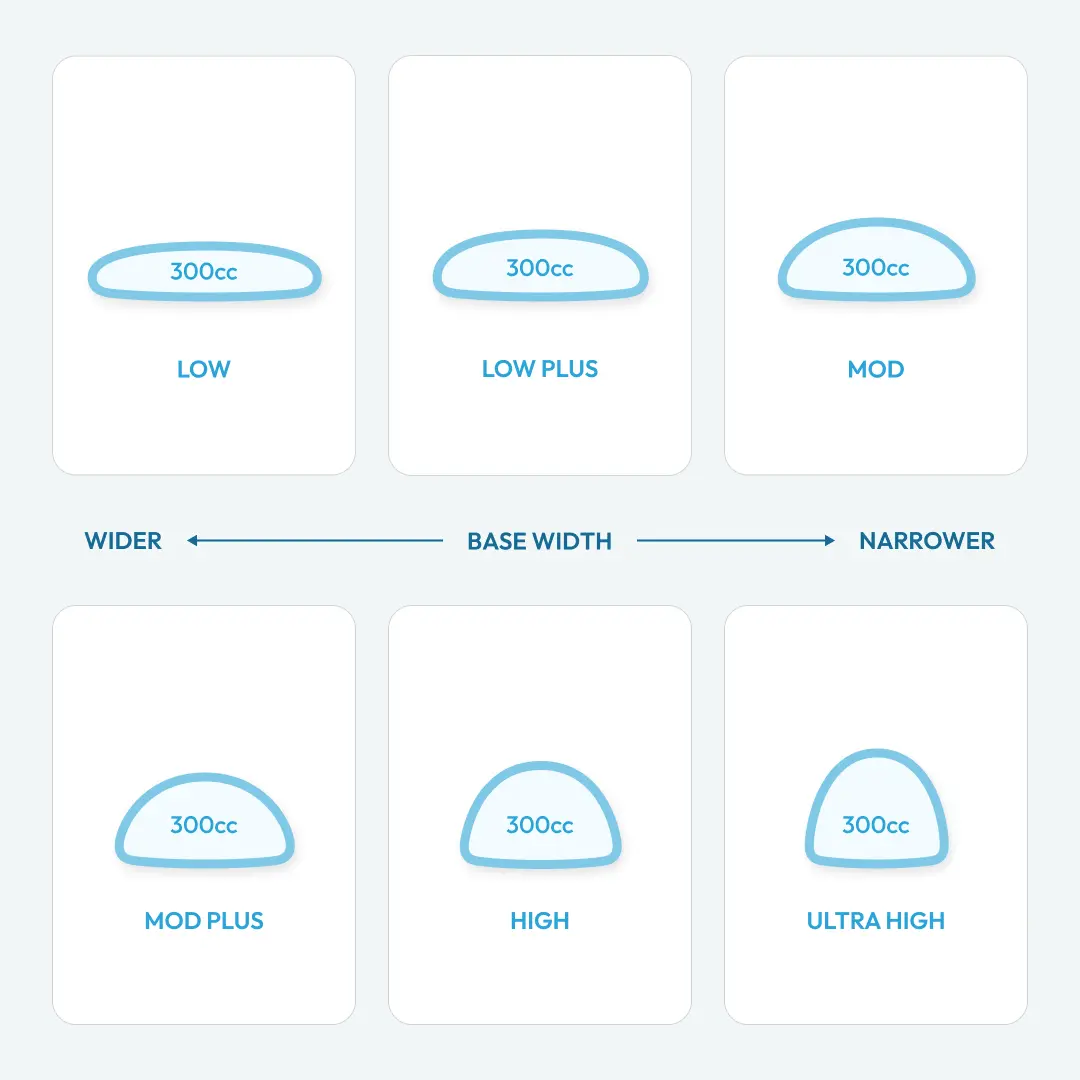
For subtle augmentation:
- Lower or moderate profiles often create a more natural, evenly distributed fullness
- Higher profiles create more projection and upper fullness
Can I stay the same bra size and just “fill it out”?
This is a common goal. But technically, any implant adds volume, which typically increases cup size. However, lower profile implants can:
- Add fullness more evenly
- Fill out the top of the bra
- Create a subtle enhancement without dramatic projection
So while you may not stay the exact same size, the visual change can feel very natural.
How do I figure out what I want before my consultation?
A little self-reflection goes a long way. Start with these questions:
- When do I want to notice the change most? (Swimwear, everyday clothes, special occasions?)
- Do I want a noticeable change or something only I really see?
- What makes me hesitant: going too big or too small?
Then:
- Look at result photos (Bustmob GoalFinder is a free tool with thousands of real patient results to get an idea of what you like.).
- Save examples you like, even if you can’t explain why yet.
- Pay attention to shape, fullness, and proportion, not just size.
You don’t need to have all the answers. A good consultation is about working through those decisions together.
Is subtle augmentation the “right” choice?
There’s no single right answer. Some patients want a more dramatic transformation. Others want something so natural it’s hard to tell they’ve had anything done.
What matters most is:
- Your Goals
- Your Comfort
- Your Lifestyle
Subtle augmentation isn’t a lesser option; it’s simply a different one. And with today’s technology and techniques, it’s more achievable than ever.
At the end of the day, this is a shared decision-making process. The goal isn’t to tell you what you “should” do. It’s to help you understand your options and choose what feels right for you.
Meet Dr. Trace Browne

Dr. Trace Browne is a board-eligible plastic surgeon in Raleigh, North Carolina. He’s known for a thoughtful, patient-first approach that prioritizes listening, education, and creating a plan that feels right for you. Whether you’re just starting to explore your options or you’ve been thinking about surgery for a while, Dr. Browne takes the time to understand your goals, answer your questions, and help you feel confident in every step of the process.
Dr. Browne earned his medical degree from the Medical College of Georgia, graduating summa cum laude. He was inducted into Alpha Omega Alpha, one of the highest honors in medical education. He went on to complete his plastic and reconstructive surgery residency at Wake Forest Baptist Health, where he trained in a wide range of cosmetic and reconstructive procedures.

Ready to start your journey?

.jpg)